


When it comes to numbers, few things spark curiosity like decimals and fractions. Take .33333, for instance. It may seem like just a string of threes, but it holds a secret that can boggle the mind and impress friends at parties. This seemingly simple decimal isn’t just a number; it’s a gateway to understanding the fascinating world of rational numbers.
Understanding Decimal Representations
Decimals represent values as fractions of ten. The decimal .33333 serves as a perfect example of this concept, showcasing its importance in the world of numbers.
What Is .33333?
The decimal .33333 approximates one-third. It repeats infinitely in the decimal format, indicating its non-terminating nature. Many perceive .33333 as merely a numerical representation, yet it illustrates a specific quantity. Converting .33333 into a fraction reveals its underlying structure: it equals 1/3. This fraction signifies equal parts divided into three sections, highlighting its basic relation to common fractions.
How Decimals Relate to Fractions
Decimals and fractions share a strong connection. Both express numerical values, allowing conversions between the two forms. For example, .5 translates into 1/2, indicating half of a whole. Understanding decimals as fractions expands comprehension of rational numbers. Moreover, intervals like .25, .5, and .75 can easily morph into 1/4, 1/2, and 3/4, respectively. These relationships establish a seamless flow between whole numbers, decimals, and fractions.
Converting .33333 to a Fraction
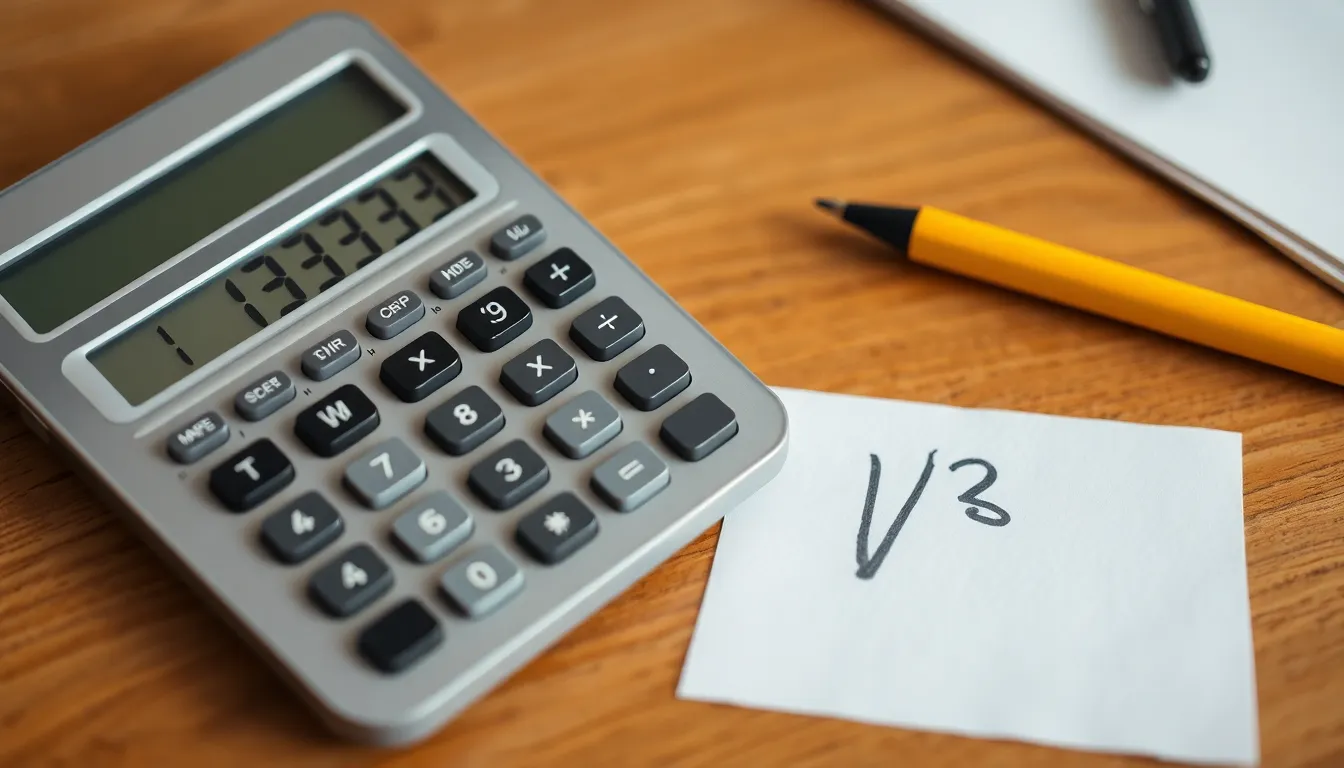
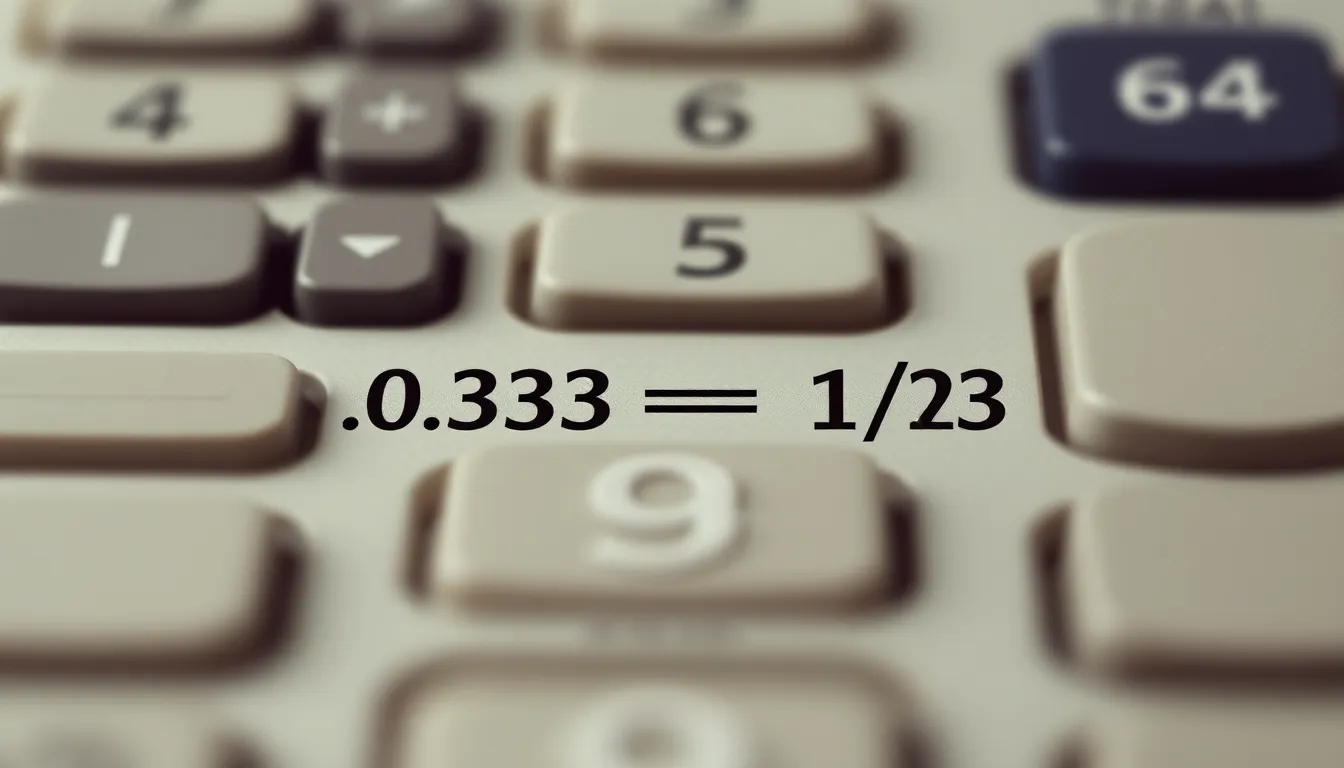
Converting .33333 to a fraction simplifies understanding its value. The process involves a straightforward method that yields the equivalent fraction form.
The Method of Conversion
To convert .33333 into a fraction, express it as 33333/100000. This uses the ten-thousandth place to show the decimal’s value. Next, simplify this fraction. The greatest common divisor of 33333 and 100000 is 33333. Dividing both numerator and denominator by 33333 gives 1/3. That shows the decimal .33333 equals the fraction 1/3.
Common Mistakes to Avoid
Many people mistakenly believe .33333 is equal to 1/2. That confusion arises because decimals can obscure their fractional equivalents. Another common error involves rounding .33333. Rounding changes 1/3 into a decimal like .33, which misrepresents its precise value. Therefore, verifying the equivalence of decimals and fractions enhances clarity and accuracy.
Visual Representation of .33333
Visualizing .33333 as a fraction enhances comprehension of its value. This decimal approximates one-third, demonstrating its connection to rational numbers.
Graphical Comparison with Other Fractions
Graphs illustrate .33333 alongside similar fractions like 1/3 and 2/6. Using bar or pie charts, one can see how .33333 occupies one-third of a whole. Visual comparisons clarify the relationship between these fractions. Additionally, serving as a reference, .66667 can appear next to .33333 to show the progression toward a whole. Such representations highlight differences and similarities, making it easier to grasp the concept of fractions visually.
Importance of Visuals in Understanding
Visuals simplify the learning of decimals and fractions. Charts and diagrams provide immediate insights into the size and relation of numbers. Understanding how .33333 fits into complex numerical systems becomes intuitive with visuals. For example, using number lines enables quicker comparisons between fractions and decimals. Moreover, associating decimals with familiar images reinforces their significance. These visual tools enhance retention and promote a deeper grasp of mathematical concepts.
Applications of .33333 as a Fraction
.33333 has practical applications across various domains. In finance, .33333, representing one-third, often appears in scenarios involving profit sharing or resource allocation.
Real-World Examples
Many food recipes use fractional measurement, such as 1/3 cup of an ingredient. A recipe needing .33333 cups emphasizes the necessity for precise measurement to maintain flavor consistency. In sports, scoring systems may utilize fractions, particularly in certain scoring methods. For instance, .33333 reflects one-third of the total possible points, providing a clearer performance metric.
Educational Significance
Teaching .33333 as a fraction enhances understanding of rational numbers. Students grasp the connection between decimals and fractions through exercises converting .33333 to 1/3. Class activities may include using visual aids like fraction circles or number lines. These tools allow learners to visualize the equivalence of .33333 and 1/3, reinforcing their understanding. Engaging students with real-world applications deepens their comprehension of mathematical concepts.

