


In the fast-paced world of gaming and digital creativity, a powerful graphics card can make all the difference. As technology evolves, so do the demands placed on these essential components. Gamers and professionals alike are constantly seeking the best options to enhance their visual experience and boost performance.
Graphics card reviews play a crucial role in helping consumers navigate the myriad of choices available. With detailed insights and comparisons, these reviews empower users to make informed decisions that align with their specific needs and budgets. Whether it’s for gaming, video editing, or graphic design, understanding the strengths and weaknesses of different models can lead to a significant upgrade in performance and satisfaction.
Understanding Graphics Cards
Graphics cards, also known as GPUs (graphics processing units), play a crucial role in rendering images, animations, and video for computer displays. They process complex graphics data to deliver smooth visual performance in applications ranging from gaming to professional design.
What Is a Graphics Card?
A graphics card is a hardware component that generates and outputs images to a display. It contains its own processing unit, memory, and cooling systems to handle graphic-heavy tasks efficiently. Modern graphics cards support advanced technologies such as ray tracing and AI-enhanced graphics. They come in various types, including integrated and dedicated, to suit different performance needs.
Importance of Graphics Card in Computing
A graphics card significantly impacts overall computing performance, especially in graphics-intensive applications. It accelerates image rendering, ensuring high frame rates in gaming and smooth video playback in media applications. Users engaged in video editing, 3D modeling, or complex simulations benefit from dedicated graphics cards, as these components manage high workloads effectively. Optimizing visual output enhances user experience and increases productivity in creative tasks.
Popular Graphics Card Brands
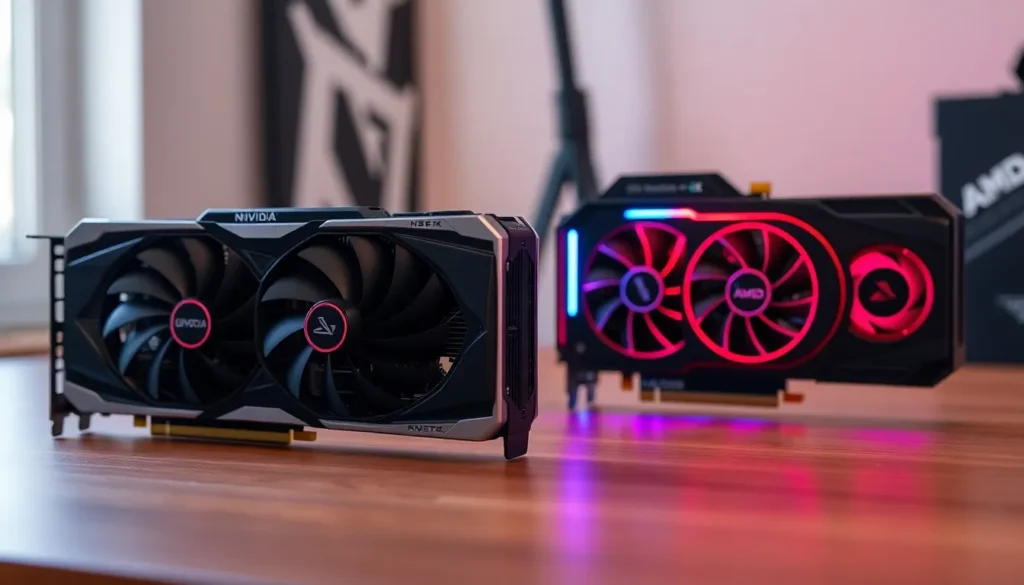
Numerous graphics card brands dominate the market, among which NVIDIA and AMD stand out. These companies provide powerful GPUs that cater to gaming enthusiasts and professionals in digital content creation.
NVIDIA Overview
NVIDIA leads the graphics card industry with innovative technology and high-performance GPUs. Its GeForce RTX series supports real-time ray tracing and AI-based features, offering significant enhancements in gaming and visual fidelity. The company’s GPUs feature advanced cooling systems, ensuring optimal performance even under heavy loads. NVIDIA also promotes technologies like G-SYNC, which synchronizes frame rates to deliver smoother visuals. Popular models include the GeForce RTX 3080 and RTX 3090, known for their exceptional gaming capabilities and support for 4K resolution.
AMD Overview
AMD provides competitive alternatives through its Radeon RX series, focusing on efficiency and performance within a budget. Its GPUs utilize RDNA architecture, enhancing performance per watt and delivering impressive power for gaming and content creation. Technologies such as FreeSync improve visual quality by reducing screen tearing and stuttering. Models like the Radeon RX 6800 XT and RX 6900 XT are recognized for their ability to handle demanding games at high settings, appealing to gamers who seek value without compromising performance.
Key Features to Consider
Evaluating graphics cards involves analyzing several key features that impact performance and user experience. These critical aspects include GPU performance, memory capacity, and power consumption.
GPU Performance
GPU performance is central to determining a graphics card’s efficiency in rendering images and videos. Factors like clock speed, number of cores, and architecture impact overall performance. Higher clock speeds and more cores typically result in better performance. For example, the NVIDIA GeForce RTX 3090 showcases superior performance through its advanced Ampere architecture, providing enhanced frame rates in gaming and smooth rendering in complex applications. In contrast, AMD’s Radeon RX 6900 XT offers competitive performance, particularly in 4K gaming scenarios, highlighting the importance of benchmarking scores and real-world tests in evaluations.
Memory Capacity
Memory capacity, often referred to as VRAM, plays a crucial role in a graphics card’s ability to handle large textures and complex graphics. Cards with 8GB or more of VRAM meet the demands of modern gaming and graphic design efficiently. For instance, a GPU with 12GB of VRAM, like the NVIDIA GeForce RTX 3080, can manage detailed environments and minimize lag. Furthermore, as game resolutions increase, higher memory capacity becomes vital for maintaining performance in demanding applications.
Power Consumption
Power consumption reflects the energy efficiency and thermal management of a graphics card. A higher wattage requirement may necessitate an upgraded power supply unit (PSU) and adequate cooling solutions. For example, the NVIDIA RTX 3090 has a power draw of around 350 watts, whereas the AMD RX 6800 XT requires about 250 watts. Lower power consumption often translates to quieter operation and less heat generation, making it essential for those prioritizing efficient builds. Users should also consider the power requirements and thermal design when selecting a graphics card to ensure compatibility with their systems.
In-Depth Graphics Card Reviews
Graphics card reviews provide essential insights into various models, enabling users to make well-informed purchasing decisions. This section delves into different categories of graphics cards, focusing on budget-friendly options, high-end performance cards, and the best choices for gaming.
Budget-Friendly Options
Budget-friendly graphics cards deliver solid performance without breaking the bank. Models such as the NVIDIA GTX 1660 Super and AMD Radeon RX 6500 XT offer excellent value for entry-level gaming and everyday tasks. These cards typically feature:
- Adequate performance for 1080p gaming settings
- Lower power consumption requirements
- Affordability for users seeking cost-effective solutions
These options can handle most modern titles at moderate settings, making them suitable for casual gamers and those on a budget.
High-End Performance Cards
High-end performance cards cater to enthusiasts demanding top-tier graphics and processing capabilities. The NVIDIA GeForce RTX 4090 and AMD Radeon RX 7900 XTX stand out in this category, featuring:
- Advanced ray tracing capabilities for realistic lighting and shadows
- Significant VRAM capacity, typically 16GB or more
- Exceptional performance in demanding applications like 4K gaming and content creation
These graphics cards excel in rendering complex scenes and handling intensive workloads, appealing to gamers and professionals alike.
Best for Gaming
The best graphics cards for gaming combine powerful performance, innovative features, and seamless gameplay experiences. Top contenders include the NVIDIA GeForce RTX 3080 Ti and AMD Radeon RX 6800 XT. Key features often include:
- High frame rates and low latency during gaming sessions
- Support for NVIDIA G-SYNC or AMD FreeSync technology
- Enhanced cooling solutions for sustained performance
These models consistently offer outstanding visual fidelity and responsiveness, making them ideal choices for serious gamers looking for an immersive experience in both single and multiplayer environments.
Comparing Graphics Card Performance
Graphics card performance comparison relies heavily on benchmarks and real-world testing. These evaluations help users understand how different models perform under various conditions and workloads.
Benchmarks and Testing
Benchmarks assess graphics card capabilities using specific metrics, providing quantitative performance data. Popular benchmarking tools include 3DMark, Unigine Heaven, and FurMark. These applications stress the GPU, measuring frame rates, rendering times, and thermal output.
Benchmarks often feature standard tests, such as:
- Synthetic Benchmarks leverage predefined scenarios to gauge performance across hardware environments.
- Gaming Benchmarks execute in-game tests at different settings to determine FPS (frames per second) and stability during gameplay.
- Thermal Benchmarks evaluate cooling efficiency by monitoring temperatures under load.
High benchmark scores typically indicate better graphics card performance. For example, the NVIDIA GeForce RTX 4090 may outperform competitors in synthetic tests, showcasing its superior ray tracing capabilities.
Real-World Performance Analysis
Real-world performance analysis offers insights into everyday graphics card usage during gaming and productivity tasks. Users often prioritize frame rates, load times, and overall stability.
Key factors in real-world scenarios include:
- Frame Rates: Consistently achieving 60 FPS or higher at 1080p or 4K resolutions validates a graphics card’s effectiveness for gaming.
- Load Times: Faster loading times in games signal efficient storage and processing capability, directly correlating with user experience.
- Stability: Consistent performance without crashes or noticeable frame drops indicates reliability, especially in long gaming sessions.
Models like the AMD Radeon RX 6800 XT demonstrate excellent performance in modern titles, achieving high FPS while maintaining thermal stability. Users seeking a balance between performance and cost may find such models particularly appealing for gaming.
Future Trends in Graphics Technology
Graphics technology is evolving rapidly, with advancements shaping the future of visual computing. Innovations promise significant enhancements in performance, efficiency, and user experience.
Upcoming Innovations
Upcoming innovations in graphics technology include developments in ray tracing, AI-driven rendering, and increased use of machine learning. Ray tracing continues to improve, achieving more realistic lighting and shadow effects in real time. AI-driven techniques optimize rendering processes, enhancing image quality with minimal performance loss. Additionally, machine learning technologies contribute to better resource allocation, reducing latency and improving overall efficiency in graphics processing.
Furthermore, next-generation GPUs are embracing higher memory bandwidth and faster clock speeds, enabling superior performance in demanding applications. The integration of hardware and software optimizations will enhance compatibility across various platforms, especially in gaming and creative content creation. This shift towards high-bandwidth memory solutions ensures seamless performance for complex tasks, ensuring users benefit from immersive experiences.
Predictions for the Industry
Predictions for the graphics card industry suggest a heightened emphasis on power efficiency and sustainable practices. As environmental concerns grow, manufacturers will likely focus on creating energy-efficient GPUs that consume less power without sacrificing performance. Increased competition between major players, including NVIDIA and AMD, will drive innovation, resulting in more affordable and capable graphics cards.
Moreover, the move towards virtual and augmented reality will necessitate advancements in graphics technology. As users demand more immersive experiences, graphics cards must support higher resolutions and frame rates, maintaining fluid gameplay and realistic environments. Anticipated partnerships between tech companies may also lead to breakthroughs, merging expertise in AI, machine learning, and graphics hardware design.
Overall, staying informed about these trends equips consumers to make better decisions when selecting graphics cards for their needs, ensuring optimal performance in gaming, video editing, and beyond.
Choosing the right graphics card is essential for anyone looking to enhance their gaming or creative experience. With a plethora of options available understanding the strengths and weaknesses of each model can make a significant difference. Graphics card reviews serve as a valuable resource guiding users through the complexities of performance metrics and technological advancements.
As graphics technology continues to evolve staying informed about the latest trends will empower consumers to make informed decisions. Whether opting for budget-friendly models or high-end powerhouses the right graphics card can elevate performance and satisfaction. Investing time in research will ultimately lead to a more rewarding experience in gaming and digital creativity.

