
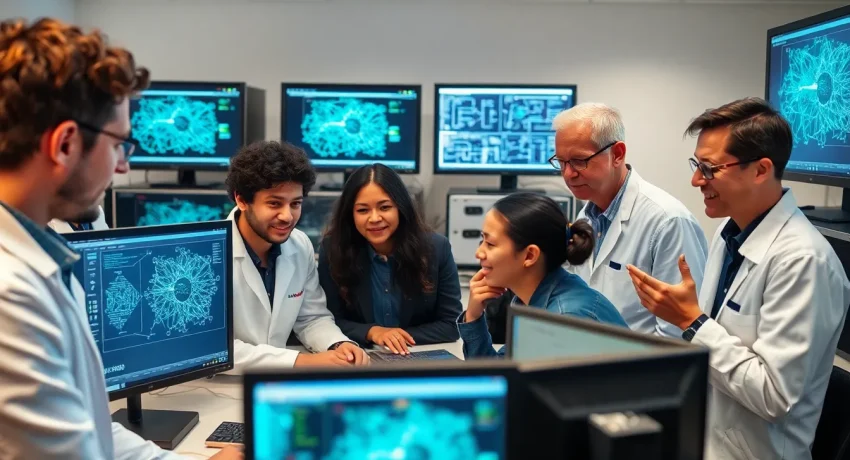

Neural networks might sound like something from a sci-fi movie, but they’re very much a part of our everyday lives. These clever systems mimic the human brain, processing information in ways that make them incredibly powerful tools in fields like healthcare, finance, and even entertainment. Imagine a world where computers can learn, adapt, and make decisions—sounds like magic, right?
Overview of Neural Networks
Neural networks represent sophisticated systems that emulate human brain functions. These systems are crucial in modern technology, allowing machines to process vast amounts of data.
Definition and Key Concepts
Neural networks consist of interconnected nodes called neurons. Each neuron processes input data and passes the output to subsequent neurons in layers: input, hidden, and output layers. Learning occurs through algorithms adjusting weights, which optimize the network’s performance. Activation functions play a pivotal role by determining if a neuron should activate based on received data. These concepts enable neural networks to recognize patterns, classify information, and perform regression tasks efficiently.
History and Evolution
Neural networks trace their origins back to the 1940s with the development of the perceptron. Researchers aimed to create models that emulate human cognition. Over the decades, advancements in computing power and data availability fueled growth in this field. By the 1980s, backpropagation emerged, enhancing training methods significantly. Recent innovations in deep learning have revolutionized neural network applications, leading to breakthroughs in image and speech recognition, making them vital across various sectors.
Types of Neural Networks

Neural networks encompass various types designed for specific applications. Understanding these types highlights their unique characteristics and functions.
Feedforward Neural Networks
Feedforward neural networks operate in one direction. They process inputs through the layers, transforming them step by step without cycling back. Each neuron in the hidden layer receives the output from the previous layer and applies an activation function. Often used in pattern recognition, these networks excel in tasks like image classification. For example, they serve effectively in basic classification problems, where a clear input-output mapping exists.
Convolutional Neural Networks
Convolutional neural networks specialize in processing grid-like topologies. Typically used in analyzing visual imagery, they utilize convolutional layers to detect patterns such as edges or textures. A key feature is their ability to reduce the number of parameters through shared weights and local receptive fields. CNNs are predominant in fields like computer vision, enabling tasks such as facial recognition and object detection. As a result, these networks handle high-dimensional data with increased efficiency.
Recurrent Neural Networks
Recurrent neural networks excel in processing sequential data. They feature loops in their architecture, allowing information to persist across time steps. This design enables RNNs to understand context and dependencies in sequences. Common applications include natural language processing and time series prediction, where the order of information significantly matters. For instance, RNNs facilitate language translation by interpreting the sequence of words in context.
Applications of Neural Networks
Neural networks have transformative applications across various fields, enhancing efficiency and accuracy.
Image Recognition
Image recognition leverages convolutional neural networks (CNNs) to identify and classify objects in images. CNNs analyze visual data by detecting patterns through multiple layers. They excel at tasks such as facial recognition, where accuracy is crucial. Data from extensive image datasets train these networks, improving their performance in identifying nuances. Various industries utilize image recognition; for instance, security systems enhance safety by recognizing faces and flagging anomalies. Additionally, retail employs image recognition for inventory management and customer engagement, streamlining operations significantly.
Natural Language Processing
Natural language processing (NLP) utilizes recurrent neural networks (RNNs) to understand and interpret human language. RNNs process sequences of words to predict subsequent text, facilitating tasks like sentiment analysis and language translation. Techniques such as word embeddings help capture contextual meanings, improving comprehension. Many applications rely on NLP, including virtual assistants and chatbots that provide real-time customer support. Social media platforms also analyze user-generated content for trends and sentiments, enhancing engagement strategies and content recommendations using advanced NLP techniques.
Predictive Analytics
Predictive analytics harnesses neural networks to analyze vast datasets and forecast future outcomes. Feedforward neural networks, often used for this purpose, identify patterns and trends within historical data. Businesses rely on predictive analytics for decision-making; for example, companies assess market trends to optimize inventory levels. Financial institutions apply these analytics to anticipate market fluctuations and manage risk effectively. Moreover, healthcare providers leverage predictive models to forecast patient outcomes and allocate resources efficiently, ultimately improving patient care and operational efficiency in clinical settings.
Advantages and Challenges
Neural networks offer numerous advantages alongside certain challenges that require attention.
Benefits of Using Neural Networks
Neural networks excel in pattern recognition, allowing them to identify complex relationships within data sets. Their capacity to learn from vast amounts of data leads to improved decision-making in various applications. Efficiency increases as neural networks adapt over time, enhancing outcomes in fields such as healthcare and finance. Specific tasks, like image and speech recognition, benefit greatly from their ability to process high-dimensional data. Businesses often find that utilizing neural networks results in significant cost savings and improved performance across specific operations.
Limitations and Ethical Considerations
Certain limitations exist when using neural networks, particularly in their interpretability. Understanding how decisions are made can be challenging due to the complexity of these models. High computational costs can be a barrier for some organizations, making implementation difficult. Ethical considerations also arise, including potential biases in training data that may lead to unfair outcomes. Addressing these issues is critical to ensure responsible use, as the reliance on neural networks continues to grow across various sectors, from technology to healthcare.
Future Trends in Neural Networks
Neural networks are set to evolve significantly, driven by advancements in technology and growing industry demands. With innovations in hardware and software, these systems are becoming faster and more efficient.
Advancements in Technology
Progress in computational power, particularly through graphics processing units (GPUs) and tensor processing units (TPUs), enhances training speeds. These technologies can process massive datasets more effectively, making complex models manageable. Researchers are exploring novel algorithms to optimize neural network training, reducing resource consumption. Improved frameworks like TensorFlow and PyTorch simplify the development process, allowing greater accessibility for developers and researchers. Additionally, emerging techniques like transfer learning accelerate training phases across varied applications, ensuring quicker deployments in real-world scenarios.
Potential Impact on Various Industries
Healthcare sectors incorporate neural networks for predictive analytics and personalized medicine. For instance, they enhance diagnostic accuracy, leading to better patient outcomes. In finance, these networks assist in fraud detection and algorithmic trading, increasing efficiency and security. Retailers utilize neural networks to personalize customer experiences, leveraging data for tailored recommendations. Manufacturing industries improve quality control and streamline supply chains through automation powered by neural networks. Lastly, energy sectors employ these systems to optimize resource allocation and enable smarter grid management, paving the way for sustainability.
Conclusion
Neural networks are revolutionizing how various industries operate by enhancing efficiency and accuracy. Their ability to learn from data and adapt to new information makes them invaluable in fields like healthcare, finance, and entertainment. As technology continues to advance, the potential applications of neural networks will only expand, offering innovative solutions to complex problems.
However, it’s crucial to address the challenges associated with these systems, including interpretability and ethical considerations. By fostering responsible development and deployment, society can harness the full power of neural networks while mitigating risks. The future holds exciting possibilities as these technologies evolve, promising to transform everyday life in ways that were once unimaginable.

