


Muscle tissue is the unsung hero of the human body, tirelessly working behind the scenes to keep us moving, lifting, and even dancing like nobody’s watching. But when it comes to crossword puzzles, it can feel like those muscle components are playing hide and seek. If you’ve ever stared blankly at a clue about muscle tissue and wondered if your brain’s gone soft, you’re not alone.
Overview of Muscle Tissue
Muscle tissue consists of specialized cells that enable movement throughout the body. Three primary types of muscle tissue exist: skeletal, cardiac, and smooth. Each type plays a distinct role in bodily functions and performance.
Skeletal muscle tissue, known for voluntary control, facilitates movement through contractions. It connects to bones via tendons, making it essential for activities ranging from walking to lifting. This muscle type appears striated under a microscope, reflecting its organized structure.
Cardiac muscle tissue, unique to the heart, functions involuntarily to pump blood. It has specialized cells called cardiomyocytes that exhibit rhythmic contractions. The intercalated discs found in this tissue promote synchronized heartbeats, ensuring efficient blood circulation.
Smooth muscle tissue, lining the walls of internal organs, operates involuntarily as well. This type lacks striations and contracts more slowly than skeletal muscle. Smooth muscle plays a vital role in digestion, blood vessel regulation, and respiratory function.
Understanding these components leads to better insight when solving crossword clues related to muscle tissue. Often, participants encounter terms like “myofibril” or “sarcomere,” which refer to muscle cells’ structural units. Recognizing these terms can simplify answering related questions in puzzle contexts.
Overall, muscle tissue’s components and functions are integral to human physiology. They contribute to various actions, highlighting the body’s complexity and the importance of muscle health and function.
Common Components of Muscle Tissue
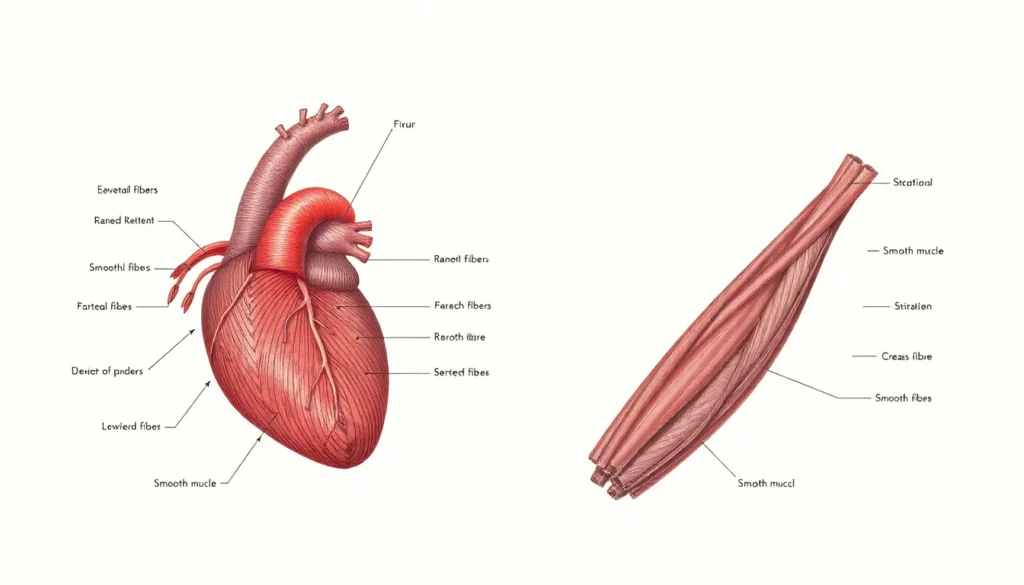
Muscle tissue contains several key components that contribute to its unique functions. Recognizing these elements aids in understanding muscle physiology and solving related crossword clues.
Skeletal Muscle Fibers
Skeletal muscle fibers consist of long, cylindrical cells. These cells aid in voluntary movements. Striations on the fibers create a patterned appearance. Each skeletal muscle fiber contains multiple nuclei. Myofibrils, responsible for contractions, run parallel to the length of the fiber. Sarcomeres are the repeating units within myofibrils, enabling contraction through actin and myosin filaments. Tendons connect these fibers to bones, facilitating movement.
Cardiac Muscle Fibers
Cardiac muscle fibers make up the heart’s muscular walls. These fibers operate involuntarily, facilitating blood circulation. Intercalated discs link adjacent cardiac muscle cells. Such connections allow for synchronized contraction. Unlike skeletal muscle fibers, cardiac fibers typically contain one or two nuclei. Striations also appear on cardiac muscle fibers, similar to skeletal fibers. The rhythmic contraction of cardiac muscle propels blood through the circulatory system.
Smooth Muscle Fibers
Smooth muscle fibers exhibit a spindle-like shape, making them distinct. These fibers operate involuntarily within various internal organs. Located in the walls of blood vessels and digestive tract, they regulate internal movements. Unlike skeletal and cardiac muscles, smooth muscle fibers lack striations. Each fiber contains a single nucleus that controls its function. Smooth muscle contraction aids in processes such as digestion and blood flow regulation. These characteristics are vital for understanding the overall function of muscle tissue.
Crossword Clue Insights
Crossword puzzles often include clues related to muscle tissue. Understanding these clues enhances solving strategies and knowledge.
Popular Clues and Answers
Common clues may include terms like “muscle unit,” often answered as “sarcomere.” Additionally, “contractile protein” frequently points to “myosin” or “actin.” Another popular clue is “muscle tissue type,” which typically suggests “skeletal,” “cardiac,” or “smooth.” Other clues like “heart muscle” commonly relate to “cardiac.” Familiarity with these terms aids in quick identification during puzzle-solving.
Tips for Solving Crossword Puzzles
Focusing on muscle tissue vocabulary allows for efficient clue interpretation. Seek out definitions that clarify the functions of muscle types, as it provides context. Utilize online resources or dictionaries to confirm terms when uncertainty arises. Collaborating with peers can also lead to quick answers. Regular practice with puzzles enriches familiarity with common clues. Understanding skeletal, cardiac, and smooth muscle characteristics contributes significantly to solving clues accurately.
Resources for Muscle Tissue Research
Numerous resources support muscle tissue research, enhancing understanding of its complex structure and function. Academic journals like The Journal of Muscle Research and Cell Motility present peer-reviewed research and discoveries in muscle biology. These articles provide insights into new findings and advancements in muscle physiology.
Textbooks offer comprehensive overviews of muscle tissue types, components, and functions. Titles such as Human Physiology by Stuart Fox and Skeletal Muscle: A Practical Approach by Simon E. Baker are essential for anyone studying these topics. Key concepts in these works furnish foundational knowledge necessary for deciphering crossword clues.
Online databases serve as valuable tools for retrieving scientific articles. Resources like PubMed and Google Scholar allow access to a vast array of studies related to muscle tissue. These platforms enable investigators to explore specific areas, such as muscle contraction mechanisms or muscle cell types.
Websites dedicated to anatomy and physiology contain detailed descriptions of muscle tissue structures. The Visible Body and InnerBody are excellent platforms for visualizing muscle anatomy. By utilizing these resources, individuals gain a clearer understanding of various components and their functions.
Additionally, educational videos can enhance learning experiences. YouTube channels, such as CrashCourse and Khan Academy, provide engaging content on muscle physiology. These visuals can aid in grasping complex concepts, making it easier to answer related crossword clues.
Networking with professionals in the field offers practical insights and firsthand knowledge. Attending workshops, seminars, or conferences related to muscle research fosters collaboration. Engaging with experts keeps individuals updated on the latest developments in muscle science.
Understanding the components of muscle tissue is essential for anyone tackling related crossword clues. Familiarity with terms like “myofibril” and “sarcomere” can significantly enhance solving strategies. By recognizing the distinct characteristics of skeletal, cardiac, and smooth muscle, crossword enthusiasts can approach these clues with greater confidence.
Utilizing resources such as academic journals and anatomy websites can further deepen knowledge and improve puzzle-solving skills. With practice and collaboration, individuals can navigate the complexities of muscle tissue terminology and enjoy the challenge of crossword puzzles even more.

